Suzi Jenner is a qualified hypnotherapist, counsellor and weight loss coach with 13+ years working with women 40+.
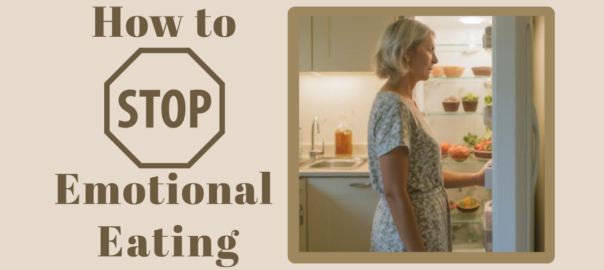
It’s 8pm. You’ve had a long day. You’re tired and maybe a little flat, and you find yourself standing in front of the pantry looking for something without knowing exactly what you’re looking for.
You’re not hungry. You ate dinner two hours ago. But there’s this pull.
If you’ve ever been here, you know what I mean. And if you’ve tried to think your way out of it with more willpower, more awareness, more strict rules about after-dinner eating – you also know that those strategies produce mixed results at best.
Here’s what’s actually going on, and what actually helps.
Emotional eating is not a weakness
At some point, food worked for you. It provided comfort during stress, relief during loneliness, a reward after effort, a distraction from something difficult. Your nervous system learned: when I feel this way, food helps.
That’s not a character flaw. That’s a learned pattern – one that made sense at the time and has been reinforced so many times it now runs automatically.
By midlife, this pattern has often been running for decades. Hormonal changes during perimenopause can amplify it further – cortisol rises, serotonin dips, and the emotional intensity that triggers the pattern becomes harder to manage.
You’re not fighting a bad habit. You’re navigating a well-worn neurological pathway that your body has come to rely on. That requires a different kind of response than trying harder.
What doesn’t work (and why)
Restriction and rules tend to intensify the cycle rather than break it.
When food becomes more forbidden, it becomes more compelling. And when you inevitably eat the thing you weren’t supposed to, the shame that follows often triggers more emotional eating.
Sheer willpower runs out, especially in the evenings when mental resources are depleted. It treats the symptom – the hand reaching into the pantry – and ignores the source.
Awareness alone doesn’t break the pattern either. You can know perfectly well that you’re about to eat emotionally and still do it. Knowing isn’t the same as having somewhere else to go with what you’re feeling.
What actually helps
The craving is information. When you get curious about it rather than trying to suppress it, you can start to understand what it’s actually telling you.
Is it boredom? Loneliness? A need to decompress after a stressful day? A way of giving yourself something at the end of a day where you’ve given everything to everyone else? The food is a solution to something. Finding out what it’s solving gives you more options.
Building other ways to meet that need – genuinely satisfying alternatives, not punishing substitutes – is the slow and real work. This takes time and self-compassion, not another set of rules.
The deeper work involves addressing the identity piece. Emotional eating tends to persist when your subconscious identity is still ‘someone who copes with food.’ When that shifts – genuinely, from the inside – the pull toward the pantry changes character. It becomes something you notice and navigate, rather than something that runs you.
This isn’t an overnight process. But it’s a real one. And it produces a kind of freedom that no meal plan can touch.
Learn about the Weight Freedom Mastery program.
Suzi Jenner is a weight loss coach, counsellor and hypnotherapist based in Caversham, Western Australia. She is the author of The Balanced Mind Diet and creator of Weight Freedom Mastery. coachingwithsuzi.com


